
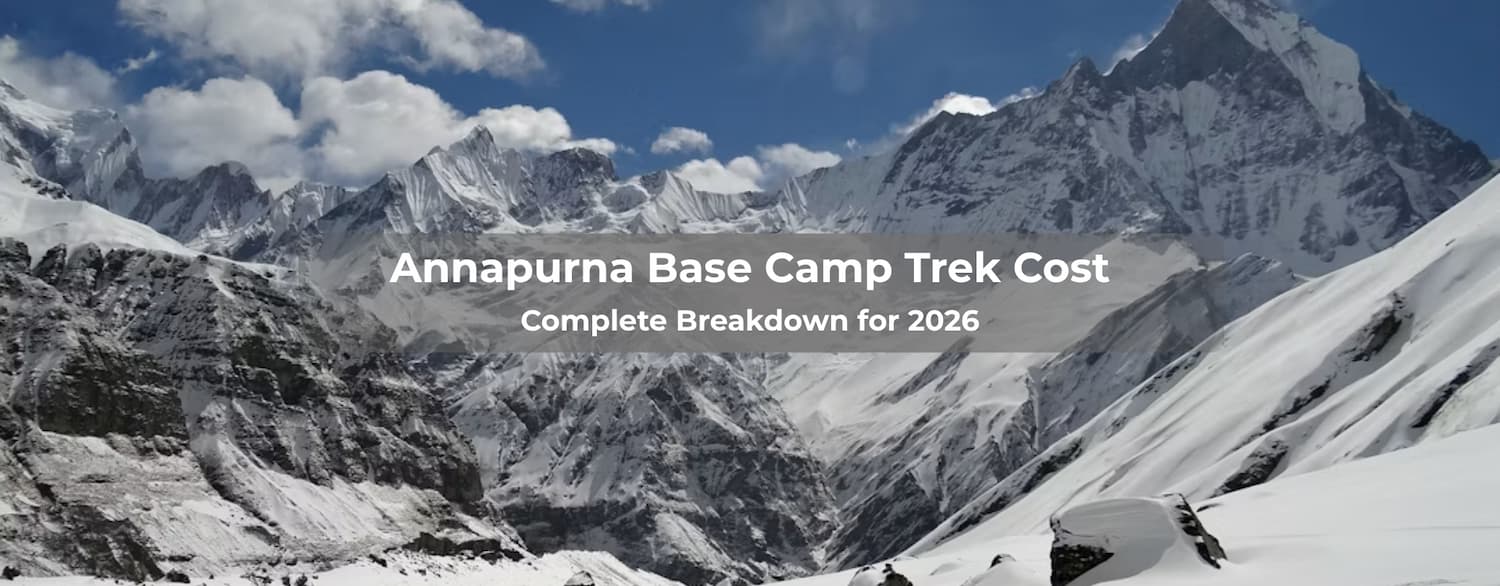
The Annapurna Base Camp trek costs between $700 and $1,800 per person in 2026. Where you land in that range depends on a few practical choices: how much support you hire, when you go, and what kind of bed you want at the end of each day.
This guide breaks that cost down by category: permits, guide and porter fees, food, accommodation, transport, insurance, and the smaller expenses most planning articles skip.
2026 cost at a glance—per person
| Trek Style | Total Estimate | Daily Spend (approx.) |
|---|---|---|
| Budget | $700 – $1,050 | ~$35 – $50 / day |
| Standard | $1,050 – $1,500 | ~$55 – $80 / day |
| Comfort | $1,500 – $1,800 | ~$90 – $130 / day |
| Want an exact breakdown for your dates? Get in touch with us to know full breakdown of your budget with no hidden cost at all. |
Confused on which trek style to take? Take a look at our budget vs. luxury trek breakdown for an easier decision.
| Not included in these figures: International flights, Kathmandu accommodation, pre- or post-trek meals in Pokhara, and souvenirs. Add $200–$400 for those depending on your choices. |
What does the Annapurna Base Camp trek cost in 2026?
Six cost categories account for nearly everything you will spend on trail. Here is what each looks like across the three trekking styles, based on a standard 14-day itinerary starting and ending in Pokhara.
Per-trek cost breakdown—14-day itinerary, per person
| Category | Budget | Standard | Comfort |
|---|---|---|---|
| Permits (ACAP + TIMS) | $42 – $45 | $42 – $45 | $42 – $45 |
| Guide & porter | $280 – $390 | $630 – $800 | $770 – $980 |
| Accommodation (14 nights) | $42 – $140 | $140 – $210 | $210 – $280 |
| Food (3 meals/day, 14 days) | $196 – $280 | $280 – $390 | $390 – $504 |
| Transport | $20 – $40 | $50 – $80 | $100 – $160 |
| Insurance | $60 – $80 | $80 – $120 | $120 – $150 |
| Guide and porter fees: Included in all eBcTrails Annapurna Base Camp Trek packages. They are not charged separately on trail. |
Annapurna Base Camp trek permits in 2026
Two permits are required before you step on trail: the ACAP and the TIMS card. Together they cost approximately around $42-45 (based on the exchange rate). Neither changes with the season, your group size, or how you are trekking.
ACAP—Annapurna Conservation Area Permit (NPR 3,000 / ~$25)
The ACAP is managed by the National Trust for Nature Conservation (NTNC) and grants legal entry into the Annapurna Conservation Area, a 7,629 sq km protected zone covering the entire ABC route. The fee funds trail maintenance, wildlife conservation, and community development programs across the region.
TIMS card—Trekkers’ Information Management System (NPR 2,000 / ~$17)
The TIMS card is a safety document. It registers your name, route, and emergency contact details in a national database. If something goes wrong on trail, rescue teams use it to locate you.
Where to get them and what to bring
Both permits are available at the ACAP Office in Pokhara (Damside/Pardi) or the Nepal Tourism Board office in Kathmandu. Processing takes 20–45 minutes at quieter times; expect longer waits during peak season—October through November and March through May. Bring your passport, two passport-sized photos, and a completed application form. Photo shops near the Damside office charge around NPR 200–500 if you have not prepared them.
| Trekking with eBcTrails? Permit procurement is included in your package. Before your trek date, provide a passport copy and two passport-sized photos. We handle everything from there. |
| Permits are checked on trail At Birethanti and Chhomrong. Trekking without them means fines or a forced return to Pokhara. There are no exceptions. |
Hiring a guide and porter for the ABC trek: costs and what you need to know
Guide and porter fees are the biggest variable in your ABC trek budget. Depending on group size and service level, they account for 35–50% of total trail costs.
The 2023 mandatory guide rule
In 2023, the Nepal government made licensed guides mandatory for all trekkers on the Annapurna Base Camp trail. Solo independent trekking without a licensed guide is no longer a grey area—it is prohibited by law. This is not a recommendation or a precaution. It is a legal requirement, actively enforced at multiple checkpoints on trail.
| What does this mean for your planning? If you have budgeted for an independent trek without a guide, revise that budget now. A guide is not optional on this route. International trekkers who arrive in Pokhara without one arranged will either hire last-minute at higher cost or be turned back at Birethanti. Neither outcome is worth the attempt. |
Licensed guide: role and daily rate
A licensed guide does more than point you in the right direction. On a high-altitude trek, they monitor your acclimatisation, read early signs of altitude sickness before you notice them yourself, communicate with tea house owners in Nepali, and coordinate emergency evacuations when needed. These are not incidental skills. At 4,130m, they matter.
Daily rate: $25–$40 per day, inclusive of their accommodation, meals, and mandatory government insurance. For a standard 14-day itinerary, budget $350–$560 in guide fees.
Porter: role and daily rate
A porter carries your gear—typically up to 20–25 kg—so you do not have to. The difference between carrying 8 kg and 20 kg at altitude is not a minor inconvenience. Most trekkers who skip a porter underestimate this on day one and regret it by day three.
Daily rate: $16–$25 per day. For a 14-day trek, that is $224–$350 well spent.
How to verify a guide’s credentials
Every licensed guide carries a government-issued trekking guide card with their name, photo, license number, and issue date. If arranging a guide independently in Pokhara, ask to see this card before agreeing to anything. Unlicensed guides operate without insurance, without government accountability, and without the altitude training that emergencies require.
| What to ask Can I see your government trekking guide license? A licensed guide will produce it without hesitation. If they cannot, keep looking. |
| With eBcTrails: Every guide we assign is government-licensed and carries verified credentials. Both guide fees and porter fees are covered within your eBcTrails package price—one dedicated porter per two trekkers, no hidden charges on trail. |
Guide and porter cost—14-day itinerary
| Group Size | Guide (14 days) | Porter (14 days) | Per Person Total |
|---|---|---|---|
| Solo trekker | $350 – $560 | $224 – $350 | $574 – $910 |
| 2 trekkers | $175 – $280 | $112 – $175 | $287 – $455 |
| 4 trekkers | $88 – $140 | $112 – $175 | $200 – $315 |
| Tips Not included in daily rates but strongly expected. For a 14-day ABC trek, budget $300–$500 total for your guide and $150–$250 for your porter—given as a lump sum on the final day, not daily. Full breakdown in the hidden costs section. |
Daily Annapurna Base Camp Trek cost: food, accommodation, and the extras
What meals cost on the trail
Tea house menus across the Annapurna Base Camp Trek route follow a familiar pattern: dal bhat, noodles, rice dishes, eggs, soups, and a rotating selection of Western options depending on how far up the trail you are. Prices are reasonable at lower elevations and rise steadily as you gain altitude.
Typical meal costs — lower to mid elevations
| Meal | Price (NPR) | Price (USD) |
|---|---|---|
| Dal bhat—unlimited refills | NPR 450 – 650 | $4 – $6 |
| Noodle or fried rice dish | NPR 500 – 750 | $4 – $7 |
| Western breakfast (eggs, toast) | NPR 400 – 600 | $3 – $5 |
| Pasta or pizza | NPR 600 – 900 | $5 – $8 |
| Hot drinks (tea, coffee) | NPR 100 – 250 | $1 – $2 |
| Dal Bhat is always the best value on trail Most tea houses offer unlimited refills—rice, lentil soup, vegetables, pickles, and sometimes a side of meat. For a high-calorie day at altitude, nothing matches it per dollar spent. |
Tea house accommodation
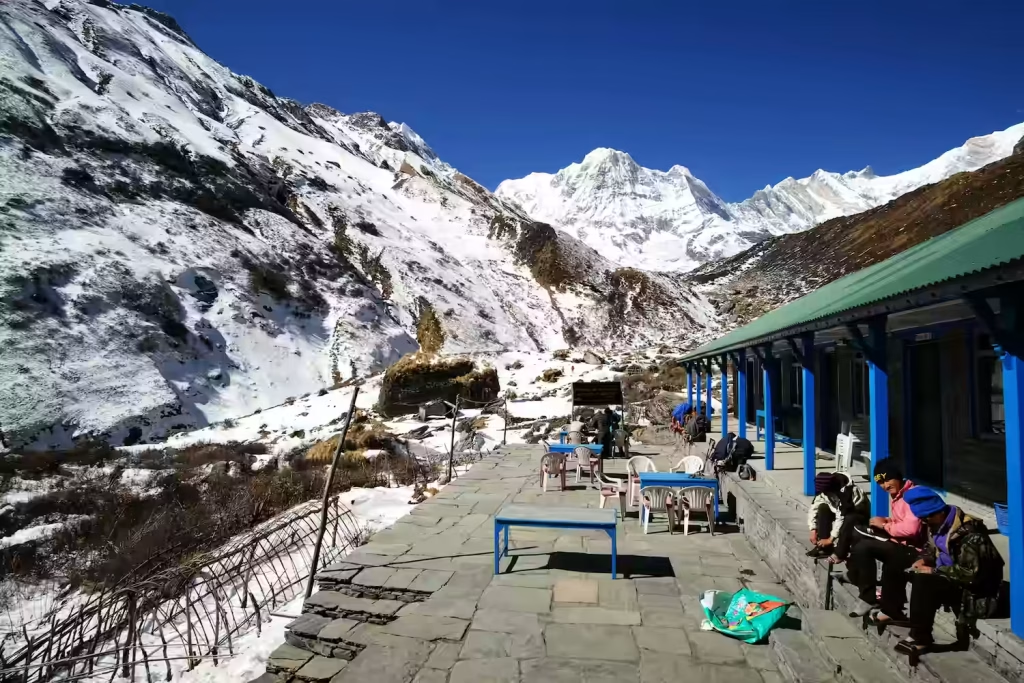
Basic tea-house rooms run $3–$15 per night depending on elevation—twin beds, a blanket, and a shared bathroom. Private rooms are available at most stops below 3,000m; above that, shared facilities become more common as infrastructure thins out. Room quality varies significantly between villages, and there is no booking system—first-come, first-served is the norm at most tea houses, particularly during peak season.
Accommodation cost by elevation
| Elevation Zone | Example Stops | Room Cost / Night |
|---|---|---|
| Lower trail (below 2,000m) | Ghandruk, Chhomrong | $3 – $8 |
| Mid-trail(2,000–3,000 m) | Sinuwa, Himalaya Hotel | $7 – $12 |
| High camps (above 3,000m) | Deurali, MBC, ABC | $10 – $15 |
Why prices rise with altitude
Every item sold at a high-altitude tea house — food, fuel, blankets, drinks — was either carried up by a porter or flown in by helicopter. There is no road access above Chhomrong. A plate of fried rice that costs NPR 450 in Ghandruk costs NPR 800–950 at Annapurna Base Camp. This is logistics, not opportunism. Factor it into your snack and hot drink budget as you go higher.
Read More: Manaslu vs. Annapurna Circuit Trek: Which one is right for you?
The extras most trekkers do not budget for
Beyond meals and accommodation, tea houses charge separately for items that add up over 14 days.
Common additional tea- and house-charge
| Item | Cost per Use |
|---|---|
| Hot shower | NPR 200–400 (~$2 – $4) |
| Phone / device charging (per hour) | NPR 100–200 (~$1 – $2) |
| Wi-Fi access (per day) | NPR 200–400 (~$2 – $4) |
| Boiled drinking water (per litre) | NPR 100–150 (~$1 – $1.50) |
| Estimated total over 14 days | $80 – $150 |
| Practical tip:Carry a water purification method — tablets or a filter — and a high-capacity power bank (10,000–20,000 mAh). Both cut your daily extras bill significantly and remove dependence on tea house Wi-Fi and charging schedules. |
Transport costs for the Annapurna Base Camp trek
Most trekkers underestimate transport costs because they only count the trail. Getting to the trailhead, returning to Pokhara, and travelling between Kathmandu and Pokhara all add to the total — and the options at each stage vary significantly in price.
Pokhara to the trailhead
The standard ABC trek starts at Nayapul, roughly 42 km from Pokhara. A public tourist bus costs NPR 300–500 ($2–5) and takes about 90 minutes. A private jeep runs NPR 5,000–8,000 per vehicle ($50–80), shared among your group. For two or more trekkers, the jeep is rarely much more expensive per person and considerably more comfortable on mountain roads.
Some itineraries push further by jeep to Siwai or Kimche, cutting 2–3 hours of lower-trail walking. The cost rises to NPR 8,000–14,000 per vehicle. Worth it for tight schedules — though the lower section through rhododendron forest is genuinely worth walking in spring.
Return transport
Most trekkers descend on foot to Nayapul or Jhinu Danda and take a jeep back to Pokhara. Expect similar pricing to the inbound journey, slightly higher during peak season when driver demand rises.
Helicopter return
A shared helicopter from Annapurna Base Camp or Jhinu Danda to Pokhara costs $250–$400 per person. A private helicopter runs $1,000–$5,000 for the flight — almost always covered by travel insurance, but you pay upfront and claim back. If helicopter return is part of your plan, arrange it before you start the trek. Booking from the top, where options are limited and weather is unpredictable, costs more and guarantees nothing.
Kathmandu to Pokhara
| Option | Cost | Travel Time |
|---|---|---|
| Tourist bus | $12 – $18 | 7 – 8 hours |
| Express / luxury bus | $18 – $28 | 6 – 7 hours |
| Domestic flight | $80 – $150 per person | 25 minutes |
| Most international trekkers fly.The time difference is significant and mountain road conditions vary by season. If your schedule is tight or you are prone to motion sickness, the flight is worth the extra cost. |
Travel insurance for the ABC trek: What it costs?
Travel insurance is not a line item to trim. A helicopter evacuation from Annapurna Base Camp costs $1,000–$5,000. Without proper coverage, that bill lands directly on you, payable before the helicopter lifts off in most cases.
What your policy must cover
- Helicopter evacuation—minimum $100,000 coverage; some Nepal operators require $500,000
- Emergency medical treatment at altitude
- Trip cancellation and curtailment
- Gear theft or loss
| Read the altitude limit in your policy. Standard travel insurance — the kind sold at airports or bundled with bank accounts — commonly excludes trekking above 3,500m or 4,000m. The ABC summit sits at 4,130m. Confirm the exact altitude limit before you purchase. |
What adequate coverage costs
A proper trekking insurance policy for a 14–18 day Nepal trip typically costs $60–$150, depending on your home country, age, and chosen provider. That figure covers you for the full evacuation scenario. It is not a place to save $30.
What a real emergency looks like
A trekker develops severe acute mountain sickness at 3,700m. The guide calls for helicopter evacuation. Weather permitting, the helicopter arrives in 4–6 hours. The flight to Pokhara takes under 20 minutes. Without insurance: $1,000–$5,000 out of pocket, paid before departure. With the right policy: $0 out of pocket, full claim reimbursed within weeks. The cost of the policy is not the variable that matters. The altitude limit clause is.
| Proof of insurance:Most licensed guides and reputable trekking agencies in Nepal require proof of valid insurance before heading above 3,000m. Carry a printed copy of your policy certificate on trail — digital access is unreliable above mid-elevation. |
Trekking agency package vs. independent: which actually costs less?
Most first-time international trekkers assume booking independently saves money. The numbers rarely support that assumption.
What a standard local agency package covers
A standard 14-day ABC package from a licensed Nepali trekking agency costs $900–$1,400 per person and typically includes permits, licensed guide, porter (one per two trekkers), three daily meals, accommodation on trail, and transport between Pokhara and the trailhead. What it does not include: international flights, Kathmandu hotel, personal gear, travel insurance, and tips.
The real independent cost
Independent trek cost—14-day itinerary, solo trekker
| Category | Cost Estimate |
|---|---|
| Permits (ACAP + TIMS) | ~$45 |
| Licensed guide (14 days at $30–$40/day) | $420 – $560 |
| Porter (14 days at $18–$25/day) | $252 – $350 |
| Accommodation (14 nights) | $100 – $200 |
| Three meals per day (14 days) | $280 – $420 |
| Transport (Pokhara to trailhead, return) | $50 – $80 |
| Insurance | $80 – $150 |
| Total | $1,224 – $1,802 |
Building independently almost always costs more than a local package and adds logistics that most first-time trekkers are not set up to handle from abroad.
Find your ideal Solo trekking destination in Nepal
Local agency vs. Western tour operator
Booking through a Western tour operator typically adds a 30–50% markup on top of what a local Nepali agency charges. In most cases, the Western operator subcontracts the trek to the same local agencies anyway.
You pay for the branding, not a different experience on the ground. For a trek in Nepal, booking directly with a licensed local agency is almost always the better financial decision.
How group size changes the math
Guide costs are fixed regardless of how many trekkers share them. Two trekkers split the guide fee in half. Four split it four ways. Porter costs scale with group size (one porter per two trekkers is standard), but guide costs do not. The per-person saving from trekking as a pair versus solo is significant — typically $175–$280 across 14 days on guide fees alone.
The Annapurna Base Camp trek Cost nobody warns you about
The sections above cover the main cost categories. These are the ones that do not appear in any package description but show up in your wallet every day.
Guide and porter tips
Tips are not contractually required. They are, however, strongly expected and genuinely deserved. Standard amounts for a 14-day trek: $300–$500 total for your guide and $150–$250 total for your porter (for the whole trek), given as a lump sum at the end of the trek.
For a solo trekker, that is $450–$750 in tips. For a pair splitting the guide cost, budget $225–$375 per person. Carry this in cash from Pokhara —do not arrive at the final tea house without local currency.
Pokhara before and after the trek
Most international trekkers spend 2–3 nights in Pokhara before departure and 1–2 nights after returning. The hotel on Lakeside runs $20–$60 per night depending on standard. Meals at Lakeside restaurants cost $8–$20 per sitting. Add gear shopping, last-minute supplies, and the inevitable Lakeside stop. Budget $150–$300 for a 3-night Pokhara stay, more if you are buying gear.
One of the recurrent problems that foreign trekkers face is not preparing the packing list beforehand, which leads to spending extra on the Annapurna Base Camp Trek cost.
Gear rental
Pokhara has a well-established gear rental market. If you are missing key items, rent here—not at trailhead villages where prices are higher and selection is limited.
Nepal Trekking Packing list to find out what you need on your next journey.
| Item | Daily Rental Cost |
|---|---|
| Trekking poles (pair) | NPR 150–300 ($1.50 – $3) |
| Down jacket | NPR 300–500 ($3 – $5) |
| Sleeping bag (rated to -10°C) | NPR 200–400 ($2 – $4) |
| Duffel bag (for porter) | NPR 100–200 ($1 – $2) |
Emergency cash buffer
Carry at least 20% more cash than your planned on-trail budget. Emergencies—an extra night due to weather, a trail injury requiring jeep evacuation, altitude medication—happen where ATMs do not exist.
For a 14-day trek, keep NPR 15,000–20,000 ($120–$160) in a separate emergency reserve and do not touch it unless you need it.
Your 2026 Annapurna Base Camp trek Cost: what to do next
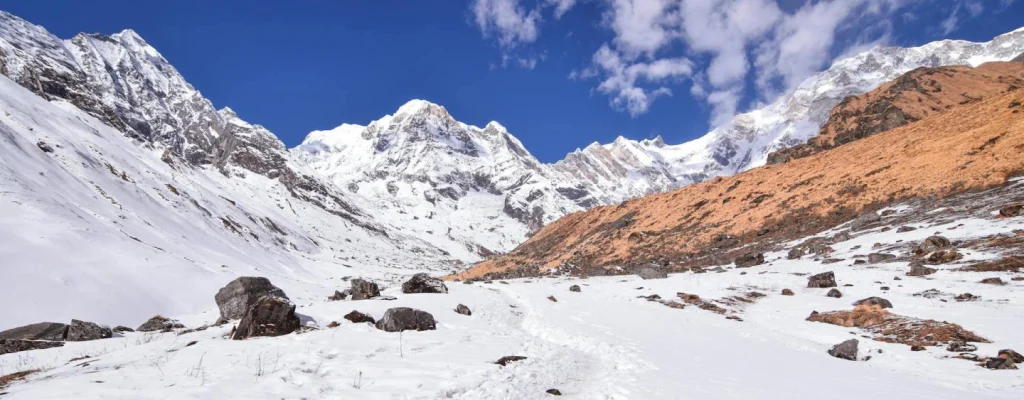
The Annapurna Base Camp trek cost in between $700 and $1,800 per person for a 14-day itinerary, depending on how you trek. That range is wide because the choices are genuinely different—not because anyone is hiding something.
| Trek Style | Total Estimate | Best Suited For |
|---|---|---|
| Budget | $700 – $1,050 | Flexible, experienced trekkers |
| Standard | $1,050 – $1,500 | First-time international trekkers |
| Comfort | $1,500 – $1,800 | Trekkers prioritising ease and time |
For the experience—14 days through Gurung villages, rhododendron forest, high alpine terrain, and one of the most dramatic base camps on earth—those figures represent serious value against almost any comparable mountain destination in the world.
What to do before you book anything
- Decide your trekking style and which budget tier fits your plan.
- Sort travel insurance first — before flights, before packages, before everything else. Confirm the altitude limit in your policy covers 4,130m.
- Book permits early if you are trekking in October, November, March, or April. Peak season checkpoints get crowded.
- Contact a licensed local trekking agency and ask for a written cost breakdown. A verbal quote is not a plan.
- Start physical preparation at least 6–8 weeks before departure. The trek rewards fitness and punishes shortcuts.
The mountains don’t charge you for the view. Everything in this guide is what you pay to get there safely.
| Planning your ABC trek with eBcTrails? Our 14-day package covers permits, a licensed guide, porter, three daily meals, and trailhead transport. Get in touch for a full written breakdown with no hidden costs. |
Want more cost breakdown? Check out our article on Everest Base Camp Trek Cost if your next journey is to the top of the world.
FAQs on Annapurna Base Camp Trek cost breakdown
How much does the Annapurna Base Camp trek cost in 2026?
The Annapurna Base Camp trek costs between $700 and $1,800 per person for a standard 14-day itinerary. Budget trekkers spending carefully on accommodation and food can reach the lower end. Standard guided packages from a local agency typically fall between $900 and $1,400. Comfort options with private transport and premium services push toward $1,500–$1,800.
What permits do I need for the ABC trek and how much do they cost?
Two permits are required: the ACAP (Annapurna Conservation Area Permit) at NPR 3,000 (~$25) and the TIMS card (Trekkers’ Information Management System) at NPR 2,000 (~$17). Total permit cost is approximately $42. Both are available at the Nepal Tourism Board office in Kathmandu or Pokhara. Your trekking agency can arrange them on your behalf.
Is a guide mandatory for the Annapurna Base Camp trek?
Yes. Since April 2023, the Nepal government requires all foreign trekkers to hire a licensed guide for the Annapurna Base Camp trail. Trekking without one is prohibited by law, not just discouraged. Checkpoints at Birethanti and Chhomrong verify guide licensing documents. Trekkers without a licensed guide are turned back at these points.
How much does a guide and porter cost per day in Nepal?
A licensed guide costs $25–$40 per day through a registered agency, inclusive of their accommodation and meals. A porter costs $16–$25 per day and carries up to 20–25 kg of your gear. For a 14-day trek, budget $350–$560 for a guide and $224–$350 for a porter, before tips.
What is the cheapest way to do the Annapurna Base Camp trek?
The most affordable approach is booking a local Nepali agency package ($900–$1,100 for 14 days), travelling to Pokhara by bus ($12–$18), and trekking in shoulder season (late February or early December). A licensed guide is legally required and cannot be skipped. Budget accommodation and dal bhat meals keep daily on-trail spending to $35–$50.
Do I need travel insurance for the ABC trek?
Yes. Travel insurance is essential for the ABC trek. Your policy must specifically cover helicopter evacuation (minimum $100,000) and emergency medical treatment at altitude above 4,000m. Standard travel insurance often excludes high-altitude trekking. A proper trekking policy costs $60–$150 for a 2-week trip. Without it, a helicopter evacuation costs $1,000–$5,000 out of pocket.
How much should I budget per day on the Annapurna trail?
Daily spending on trail ranges from $35–$50 for budget trekkers to $90–$130 for comfort-focused trekkers. This covers accommodation and meals. Budget an additional $5–$15 per day for extras — hot showers, phone charging, Wi-Fi, and boiled water. Most tea houses do not accept cards, so carry sufficient NPR cash from Pokhara.


