
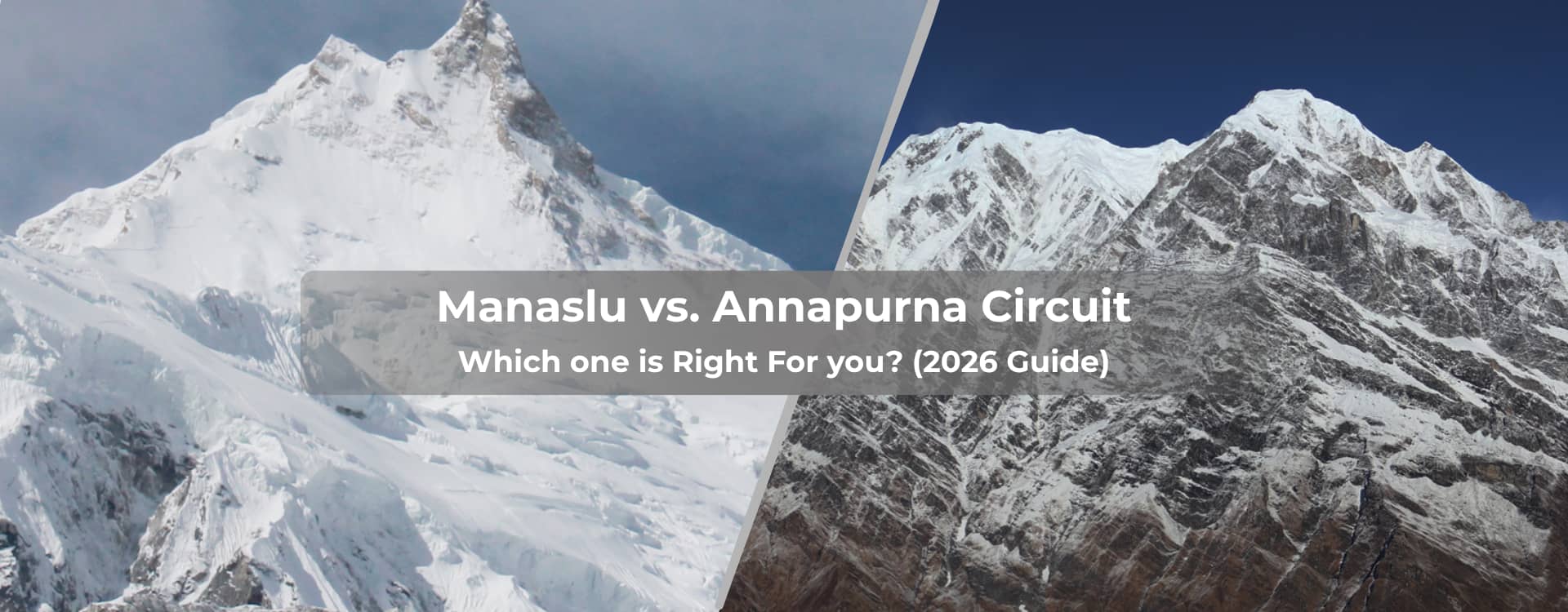
Two of the most sought-after and popular treks Manaslu and Annapurna Circuit, are rich in natural beauty and unfiltered traditions with diversity. The two contrasting trails often share many similarities with each other yet could not be more different from each other.
Both treks cross a 5000+ meter pass and both peaks are 8000+ meters high. But One ( Annapurna Circuit) will have you sharing teahouses with a number of trekkers during peak season, while another (Manaslu Circuit) might not have a fellow trekker in sight for at least three days.
This guide of Manaslu vs. Annapurna Circuit breaks down what actually separates the two treks—difficulty, permits, cost, scenery, and cultural experience—so you can make the right call for your trip.
Whether you choose the Annapurna Circuit Trek or the Manaslu Circuit Trek, eBcTrails rightly covers both of the treks with experienced guides and thorough itineraries. You can contact us if you require personalized information or for booking.
Manaslu vs. Annapurna Circuit Trek in 2026—At a Glance
| Categories | Manaslu Circuit | Annapurna Circuit |
| Duration (standard itinerary) | 14 to 18 days | 12 to 18 days (variable due to road connections) |
| Distance | ~150 km (93 miles) | ~160 to 230 km (100–145 miles), depending on transport used |
| Highest point | Larkya La Pass (5,106 m / 16,752 ft) | Thorong La Pass (5,416 m / 17,769 ft) |
| Difficulty rating | Challenging / Strenuous (remote and rougher trails) | Moderate to Challenging (more infrastructure and exits) |
| Required permits | Yes • Restricted Area Permit (RAP) • Manaslu Conservation Area Permit (MCAP) • Annapurna Conservation Area Permit (ACAP) | Yes • Annapurna Conservation Area Permit (ACAP) |
| Mandatory guide required | Yes (A minimum of two trekkers accompanied by a licensed guide is legally required) | No (A licensed guide is strongly recommended but not legally mandatory for independent solo paths) |
| Approximate total cost | $1,200 to $2,000+ USD per person (Higher upfront costs due to required agency permits/guides) | $700 to $1,500 USD per person (More budget flexibility with public transport/independent options) |
| Crowd level (peak season) | Low to Moderate (controlled by restricted permit caps) | High to Very High (very popular social trail) |
| Teahouse quality | Basic to Standard (Simpler menus, shared bathrooms, limited Wi-Fi at higher elevations) | Standard to Premium (Highly developed, diverse menus; reliable hot showers; widespread Wi-Fi) |
| Best season | Spring (March–May) and Autumn (September–November) | Spring (March–May) and Autumn (September–November) |
| Can you trek solo? | No (Requires a minimum group size of 2 plus a licensed guide.) | Yes (Independent solo trekking is logistically possible) |
Manaslu vs. Annapurna Circuit Trek Difficulty — Which One Will Actually Challenge You?
Both Manaslu and Annapurna Circuit are considered challenging treks, especially for beginners. It is graded based on all the challenges you will face during the trek, including daily hikes, type of trails, accommodation availability and destination altitude. But between the two, which do you think is more challenging?
Annapurna Circuit Difficulty
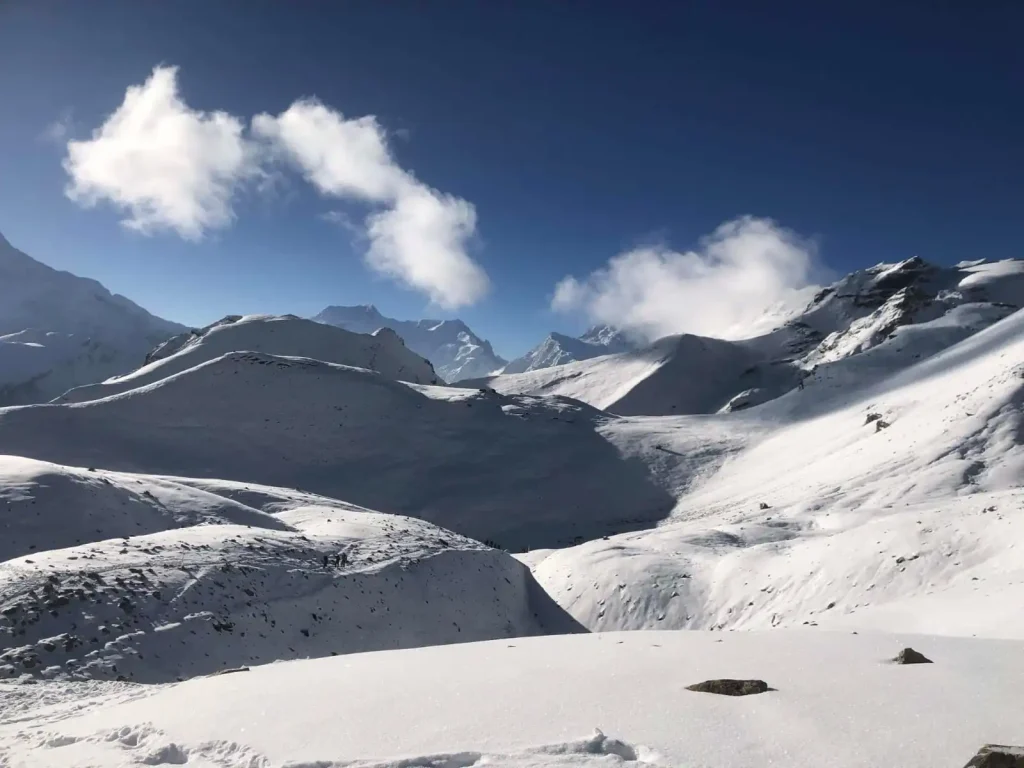
The Annapurna Circuit has always been one of the best treks in Nepal for both internal and external trekkers. Mainly due to its moderate difficulty, well-developed trails and various accommodation availabilities.
The highest point of the trek, Thorong La Pass (5,416 m), is the crux of the trek, which most fit trekkers can complete without any sort of technical difficulties.
Recent development of roads changes the experience more than altitude. Lower sections are partially paved with vehicle traffic that can steal away the feeling of ‘wilderness’ significantly. Depending on the trekkers, this can be either a good or bad development.
The popularity of the Annapurna Circuit Trek has made the settlement around the trail more developed with excellent infrastructures, altitude tents, and medical posts along the route. This type of progress is especially important for first-timers.
The route features a steady incline, and the scheduled acclimatization day in Manang effectively assists trekkers in adjusting to the altitude.
Manaslu Circuit Difficulty
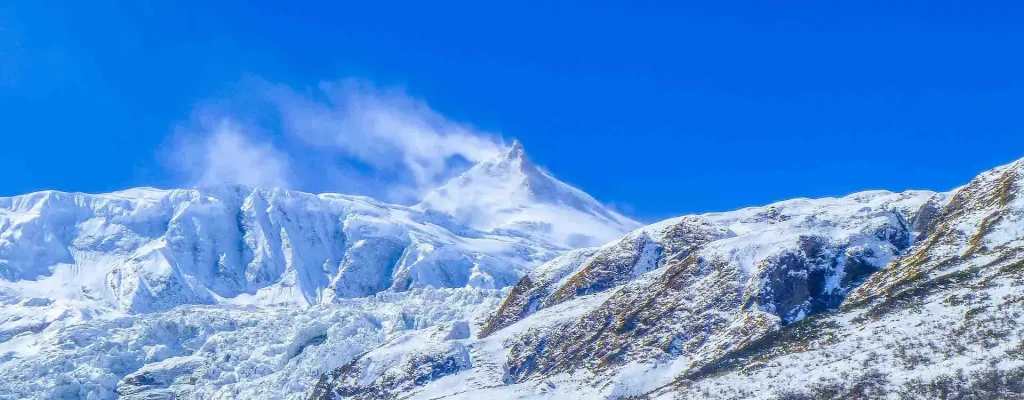
The Manaslu Circuit is generally rated as moderate-to-challenging, a designation largely stemming from the remoteness of the trail and the demands of its high mountain pass.
While its highest point, the Larkya La Pass, stands at 5,106 meters—marginally lower than the Annapurna’s Thorong La—the approach day is significantly more demanding, often stretching to an arduous 8 or 9 hours. Contributing to this challenge, the infrastructure at high-altitude camps remains distinctly basic, requiring a greater degree of self-reliance.
The trail itself is noticeably rougher than its counterpart, defined by rocky terrain, narrow sections, and exposed paths along steep cliff edges. This rugged environment, coupled with the restricted-access nature of the region, translates to significantly fewer emergency rescue options should an incident occur.
Crucially, the itinerary includes a mandatory and well-placed rest day in Samagaon (~3,500m). This stop is essential for properly adjusting to the increasing altitude, mitigating the risks associated with Acute Mountain Sickness (AMS) before the ascent to the pass.
Finally, a core difference that impacts planning is the legal requirement for a minimum group size of two trekkers accompanied by a licensed local guide. Solo trekking is strictly prohibited, a safety mechanism given the trail’s isolation but one that presents a logistical concern for independent travelers.
Our Honest Take
There are various treks to choose from in between the Manaslu and Annapurna circuits. If this is your first Himalayan trek, Annapurna Circuit’s infrastructure gives you options when you need them most—and on a mountain trek, that matters. A clear way out is usually only a few hours away. On the flip side, if you have at least one major trek done and want a real wilderness challenge, Manaslu won’t disappoint. But many people underestimate it.
At eBcTrails, our guides often report a common question about difficulty. Clients ask, “Will I be able to handle the high-altitude pass on summit day?” The reality our teams see on the ground is this: the steep, rocky climb over Larkya La Pass is grueling.
But the true challenge of Manaslu is its remote, primitive terrain. Unlike Annapurna’s accessible jeep roads, Manaslu demands steady endurance on rugged, isolated trails. There is no easy, modern exit.
Permits and Logistics—How much Planning Does Each Trek Require?
Annapurna Circuit Permits
Embarking on the classic Annapurna Circuit as an independent trekker requires securing two primary entry documents. The Annapurna Conservation Area Permit (ACAP) is priced at roughly NPR 3,000 (about $22 USD). The Trekkers’ Information Management System (TIMS) card currently costs approximately NPR 2,000 (roughly $15 USD). Unlike restricted routes, this legendary trail does not require a guide by law.
Solo hikers can trek without strict permit caps or minimum group requirements. These documents are easily obtainable in the Nepal Tourism Board office in either Kathmandu or Pokhara. If you have your passport and several passport-sized photos ready, the entire process is remarkably streamlined, typically taking only one to two hours to finalize.
Manaslu Circuit Permits
Getting the necessary permits for the Manaslu Circuit involves several required government and local documents. The most important one is the Restricted Area Permit (RAP), which costs $100 USD per person per week during the peak season (September through November).
The price drops to $75 USD per week at other times of the year. Since the trail crosses different protected areas, you also need the Manaslu Conservation Area Permit (MCAP) and the Annapurna Conservation Area Permit (ACAP), each costing NPR 3,000 (about $23 USD).
Add a local Chumnubri Rural Municipality fee of roughly $15 USD. The total cost for all permits usually averages between $190 and $250 USD per person, depending on how long your trip is. Because of strict border-zone regulations, you cannot get these permits on your own.
A legally registered, licensed trekking agency must handle the entire online application and finalize it for you in person at the Department of Immigration in Kathmandu.
Mandatory Guide Rule
The Manaslu region is designated as a restricted area under strict government rules. This means you cannot trek alone, and independent hikers are not allowed to apply for permits by themselves.
To legally start the trek, the government requires a minimum group of two trekkers, who must be accompanied by a licensed, registered guide. These strict border-zone rules may seem like unnecessary paperwork, but they actually have a major benefit for anyone seeking a true Himalayan experience.
By limiting the number of visitors, these rules prevent the trail from becoming too crowded and commercial. This restriction actively helps preserve the raw wilderness, the quiet solitude, and the unique, pristine Tibetan culture that make Manaslu so special.
eBcTrails manages this entire process for you. Our team handles every permit application step directly in Kathmandu. We secure your RAP, MCAP, and ACAP documents before your trek.
eBcTrails manages the entire permit process from Kathmandu. Contact us before your planned departure date for current fee schedules and processing timelines.
We will share the most current fee schedule.
Cost Breakdown of Manaslu and Annapurna Circuit Trek—What will you actually spend?
Annapurna Circuit (Budget range: $900–$1,400/person total)
Trekking the Annapurna Circuit is very cost-effective because it avoids expensive restricted area fees. Your required permits (ACAP and TIMS) cost an affordable total of about $37 USD. Once on the trail, daily expenses for a standard teahouse, bed, and three meals average $20 to $40 USD. This cost changes based on altitude and what you buy, like bottled drinks or snacks.
Round-trip transport from Kathmandu to the starting point (Besisahar) and back, using public buses or shared jeeps, costs an efficient $20 to $40 USD in total. Independent trekking is permitted, but hiring a licensed, English-speaking guide for safety and logistics adds a reasonable $25 to $35 USD per day.
For a completely seamless, stress-free experience, eBcTrails offers all-inclusive standard agency packages from $1,150 to $1,400 USD per person (depending on the size of your group). This price wraps your permits, dedicated guide, porter support, private local transport, and all trail meals and lodging into one clear, upfront price.
Manaslu Circuit (Budget range: $1,200–$1,800/person total)
Financial planning for the Manaslu Circuit journey begins with a comprehensive permit bundle, typically ranging from $190 to $250 USD based on seasonal rates, as the Manaslu Circuit traverses a sensitive, protected border region.
While staying in more traditional, rustic settlements, your daily expenses for basic teahouse lodging and trail meals remain economical, averaging $15 to $30 USD.
Efficient round-trip transportation from Kathmandu to the trailhead adds roughly $30 to $50 USD, while the government-mandated licensed local guide services cost between $35 and $50 USD per day.
Manaslu is more in the higher price range, as it offers more isolation, cultural depth and fewer competitors for teahouses along the road. The Annapurna Circuit, on the other hand, is relatively cheaper, but the cost can rise if you are comfortable with lodges and eating in famous restaurants.
eBcTrails handles the full permit process, guide arrangement, porter support, transport, and accommodation as a single package.
While our pricing varies depending on your group size, we offer fully customizable itineraries tailored to your specific requirements.
You can Book your adventure today easily with eBcTrails and personalize your trekking experience.
Scenery, Crowds, and the Elephant in the Room—Annapurna’s Road Problem
Annapurna Circuit’s Road Situation in 2026
The expansion of transport infrastructure within the Marsyangdi Valley has fundamentally altered the classic Annapurna Circuit experience. As of 2026, motorable dirt tracks now stretch from the gateway of Besisahar deep into the heart of Manang and even further toward Khangsar.
This shift has effectively replaced nearly a week of historic trekking trails with modern road connections. While many travelers now utilize shared jeeps to speed through these commercialized lower segments, bypassing them entirely sacrifices the breathtaking transition from subtropical terraces to the high alpine, a slow-burn progression that originally defined the circuit’s prestigious reputation.
If you arrive expecting the untouched wilderness described in vintage guidebooks, the lower valley sections may feel underwhelming. However, by skipping the dusty valley tracks and beginning your foot journey from elevated hubs like Jagat or Chame, you will find that the upper regions still offer one of the most magnificent mountain experiences on the planet.
The high-altitude core of the trek—spanning the alpine meadows of Manang, the formidable Thorong La Pass, and the desolate, wind-swept vistas of the Mustang Valley—remains entirely free of vehicles. For those seeking an authentic trekking experience away from modern road noise, eBcTrails carefully crafts itineraries that prioritize the preserved network of secondary trails:
- Using the NATT trail network: We avoid the main jeep tracks by utilizing the Natural Annapurna Trekking Trails (NATT), a series of clearly marked footpaths officially endorsed by ACAP to keep trekkers in the wild.
- The Upper Pisang Ridge: Instead of following the lower road from Chame, our routes climb toward Upper Pisang, Ghyaru, and Ngawal. This stunning ridge walk keeps you far above the modern infrastructure, passing through ancient villages where the horizon is dominated by prayer flags.
Why Manaslu’s Restricted Area Status Is a Strategic Advantage
The implementation of the Restricted Area Permit (RAP) purposefully regulates visitor volume, safeguarding the route from the heavy traffic found on more commercialized paths. Due to stringent environmental mandates that halt modern development, the Manaslu circuit remains entirely devoid of motorable roads—a state of isolation that is expected to persist for the foreseeable future.
Many veteran guides describe this region as a living time capsule of “what the Annapurna Circuit was decades ago.”
The benefit of this restricted access is most evident during the busy October trekking season. While popular lodges in Annapurna often become overbooked, leading many to rest on communal floors, the permit quota system in Manaslu ensures a tranquil trekking environment and guaranteed nightly accommodation.
- Incomparable Alpine Vistas: The journey reaches its peak in villages like Samagaon, where the massive, frozen wall of Manaslu’s North Face looms over the valley floor. The view of Manaslu’s North Face from Samagaon is, by most accounts, the most dramatic mountain viewpoint on the entire route.
- Preserved Himalayan Wilderness: Strict management of human impact has allowed the Manaslu Conservation Area to remain one of the most authentic and untouched natural environments in the high Himalayas.
- Exceptional Wildlife Sightings: Trekkers who maintain a quiet pace through high-altitude meadows have a distinct advantage in viewing rare fauna. You may witness bharal (blue sheep) or Himalayan tahr near glacial edges, see the vibrant feathers of the Danphe pheasant, or even discover traces of the legendary snow leopard in its wild native territory.
Cultural experience: breadth on Annapurna, depth on Manaslu
Nepal’s trekking regions are not culturally interchangeable. The communities you walk through, eat with, and sleep beside are shaped by altitude, history, and trade routes that go back centuries. On both circuits, culture is not background scenery—it is the substance of the trek.
But what you find on the Annapurna Circuit is fundamentally different from what you find on Manaslu, and choosing between them partly comes down to what kind of encounter you want.
Annapurna Circuit: Nepal’s ethnic range compressed into one route

Few treks cover as much cultural ground in as short a distance. Starting in the lowland foothills, the Annapurna Circuit moves through Gurung and Magar communities whose terraced farmland and stone villages have looked roughly the same for generations.
As the trail climbs past Chame and into the upper Marsyangdi valley, the architecture and religious life shift—prayer flags, mani walls, and gompas replace the Hindu shrines of the lowlands. By the time you descend into the Kali Gandaki gorge after Thorong La, you are walking through Thakali and Mustangi territory: flat-roofed houses, apple orchards, and wind-scoured streets that could be on the Tibetan plateau.
The Annapurna Circuit’s popularity has left its mark, though. Teahouses along the main route are calibrated to international trekkers. English menus and Wi-Fi are the norm from Besisahar onward. The warmth of the people is genuine regardless, but the cultural experience is mediated—you are observing communities that have had three decades to adapt to trekking tourism.
Manaslu Circuit: what Annapurna’s upper section used to feel like, but more so

The upper villages of the Manaslu Circuit—Namrung, Lho, Samagaon, and Samdo—are among the most intact Tibetan-Buddhist communities in Nepal. These are not villages preserved for tourist consumption. They are functioning places whose way of life has not been upended by mass tourism, in part because restricted area regulations keep visitor numbers low by design.
The monasteries at Lho and Samagaon are active places of worship. The ‘Mani’ walls lining the trail into Samagaon stretch for hundreds of meters, built and maintained over centuries. The architecture belongs entirely to the high Himalayan world—low stone buildings, carved wooden window frames, and flat rooftops used for drying grain. Nothing about it is staged.
What this means for trekkers is that encounters here carry different weight. A conversation with a teahouse owner in Samagaon is not the same conversation that has been rehearsed with thousands of tourists before you. That is not a criticism of anywhere on the Annapurna route — it is just what happens when a place becomes well-traveled.
Breadth versus depth
The Annapurna Circuit gives you cultural range. Over 12 to 18 days, you move through half a dozen distinct communities, each with its own architecture, dialect, and relationship to the mountains. If you want to understand the spread of Nepal’s highland cultures in a single journey, it is hard to beat.
Manaslu gives you cultural concentration. The dominant world of the circuit is Tibetan-Buddhist and it deepens as you ascend rather than changing. Trekkers who have done both often say that the Annapurna Circuit is more visually surprising—the cultural landscape keeps shifting—while Manaslu is the one that stays with them longer.
On the Manaslu route in particular, trekking with a guide who knows the region rather than just the trail makes a genuine difference. Monastery visits, context for the religious sites you pass, introductions in villages that see few outsiders—these are not things you get from a guidebook.
Find out more on Nepal’s rich culture and traditions on our Hindu Pilgrimage Tour of 8 days.
So Which Trek Is Right for You?
The Annapurna Circuit is your trek if this is your first time on a Himalayan circuit, you are heading out solo, your window is under 15 days, or you need the freedom to shorten or reroute as you go. It also suits anyone who finds value in the social dimension of trekking—the shared dinners, the impromptu trail friendships, and the sense of being part of something well-traveled and well-loved.
Manaslu belongs to trekkers with at least one serious mountain route behind them who find peak-season crowds on the trail genuinely deflating rather than merely inconvenient and who are willing to plan further ahead, spend more, and commit to a fixed itinerary with a licensed guide. It rewards people who want the mountains on harder terms.
One honest observation from years of guiding both circuits: most trekkers who have done both will tell you Manaslu is the better trek. That is only true if you arrive ready for it. The Annapurna Circuit, done properly—starting from altitude, taking the upper sections without rushing, giving Thorong La the respect it deserves—is not a fallback. It stands on its own terms as one of Nepal’s finest experiences.
Can you do both? The Manaslu–Annapurna combined trek
Most trekkers treat this as an either/or decision. It does not have to be.
Because the Manaslu Circuit ends at Dharapani—a village that sits directly on the Annapurna Circuit route—the two treks connect without backtracking. Cross Larkya La, descend to Dharapani, and step onto the Annapurna trail heading toward Chame, Pisang, and Manang. Geographically, the transition is seamless. You are following one continuous mountain route, not stitching two separate treks together.
The combined route does not feature prominently in mainstream trekking literature, partly because it demands a serious time commitment and partly because it sits outside the packaging of standard agency itineraries. For the right trekker, that is not a problem.
How long does it take?
The honest answer is it depends on how you build it.
Historically, completing both circuits separately required nearly 40 days. Improved road connectivity in the lower sections of Annapurna has brought that down considerably. Most operators now run combined itineraries in 23 to 28 days. The full range sits between 20 and 30 days depending on itinerary design and rest days, with most trekkers walking 6 to 8 hours daily.
Where your total lands depends on a few decisions. Starting point on the Manaslu section—Soti Khola or Machha Khola—affects the early days. Side trips add time: the detour to Manaslu Base Camp from Samagaon costs a day; the Tsum Valley extension adds roughly a week and is a serious undertaking on its own terms.
And on the Annapurna side, most trekkers doing the combined route take a jeep transfer from Dharapani to Chame, skipping the lower road sections to pick up the trail at altitude—a sensible call after two weeks already on foot.
A combined route without side trips, using a road transfer at Dharapani, typically runs 23 to 25 days. Factor in proper rest days at Samagaon and Manang—both are acclimatization stops, not optional padding—and 25 to 28 days is a realistic planning figure.
What permits do you need?
Less than most people expect. Both treks can be completed using the same core set of permits with a few additions. The MCAP covers the Manaslu Conservation Area. The ACAP, which Manaslu trekkers already need because the route crosses into Annapurna Conservation Area near Dharapani, covers the Annapurna section as well. The Manaslu Restricted Area Permit handles the restricted zone, and a TIMS card covers both. There is no separate Annapurna Circuit permit sitting on top of what Manaslu already requires.
The permit overlap is one of the genuinely practical arguments for doing both in sequence rather than on separate tripsThe mandatory guide requirement for Manaslu carries through the full combined route. Most trekkers keep their guide for the Annapurna section too; by week three of a continuous journey, that relationship has its own value.
Who is this for?
Not most trekkers. Four to five weeks available, a solid high-altitude record behind you, and the mental stamina for consecutive weeks at elevation without the option of cutting the itinerary short. Larkya La, at 5,106 meters on day twelve or thirteen of continuous trekking, does not get easier because Annapurna is coming. It requires the same preparation as it would on a standalone Manaslu trip.
For trekkers who meet that description, the combined route offers something neither circuit delivers on its own. You move through both regions on a path that connects remote valleys, high passes, and culturally distinct villages—the experience builds continuously, with each stage feeling genuinely different from the last. Two of Nepal’s great high passes in a single journey. The Tibetan-Buddhist world of the Manaslu upper valley, followed by the ethnic and landscape diversity of the Annapurna circuit, without breaking the thread between them.
Trekkers who have done it tend to describe it not as two treks but as one very long one. Geographically, that is exactly what it is.
FAQs on Manaslu vs. Annapurna Circuit Trek
Which trek is harder — Manaslu Circuit or Annapurna Circuit?
The Manaslu Circuit is the harder of the two. While its highest point, Larkya La Pass at 5,106 meters, sits lower than Annapurna’s Thorong La at 5,416 meters, the approach to Larkya La is significantly more demanding—typically 8 to 9 hours on rough, remote terrain with minimal infrastructure. Annapurna Circuit has better rescue access, clearer trails, and more exit options at every stage. If you are comparing the two purely on difficulty, Manaslu is the more serious undertaking.
Do I need a guide for the Annapurna Circuit?
No. The Annapurna Circuit does not legally require a guide, and independent solo trekking is permitted. A licensed guide is strongly recommended for first-time Himalayan trekkers—for safety, navigation in poor weather, and local knowledge—but it is not a legal requirement. The Manaslu Circuit, by contrast, requires a minimum group of two trekkers and a licensed guide by law. This distinction is one of the key practical differences between the two routes.
What is the best time of year to trek Manaslu or Annapurna Circuit?
Both circuits share the same optimal trekking windows: spring (March to May) and autumn (September to November). Autumn—October in particular—offers the most stable weather and clearest mountain views, making it the most popular season for both routes. Spring brings warmer temperatures and rhododendron blooms at lower elevations. Winter trekking is possible on both routes but high passes become significantly more dangerous, and Larkya La on Manaslu can be impassable after heavy snowfall. Monsoon season (June to August) is generally not recommended for either circuit.
Can I combine the Manaslu Circuit and Annapurna Circuit in one trip?
Yes, and the geography makes it straightforward. The Manaslu Circuit ends at Dharapani, which sits directly on the Annapurna Circuit route—meaning the two connect without backtracking. A combined itinerary typically runs 23 to 28 days depending on your starting point, rest days, and whether you use a jeep transfer at Dharapani to skip the lower road sections of Annapurna. Permitting overlap between the two routes means you do not need a full second set of documents. This route suits experienced trekkers with four to five weeks available and at least one major high-altitude trek already completed.
How much do Manaslu Circuit permits cost in 2026?
The Manaslu Circuit permits a total of approximately $190 to $250 USD per person depending on the season. The Restricted Area Permit (RAP) costs $100 per person per week during peak season (September to November) and $75 per week at other times. Additional permits include the Manaslu Conservation Area Permit (MCAP) and Annapurna Conservation Area Permit (ACAP), each approximately $23 USD, plus a Chumnubri Rural Municipality fee of around $15 USD. These permits cannot be arranged independently — a registered trekking agency must handle the application process on your behalf.
Final Words on Manaslu vs. Annapurna Circuit
Manaslu and Annapurna Circuit are both exceptional treks. They share the same Himalayan sky, the same best seasons, and the same fundamental reward — crossing a high mountain pass through one of the most dramatic landscapes on earth. But they are built for different trekkers at different points in their journey.
The Annapurna Circuit offers range—cultural, geographic, and logistical. It is forgiving in the right ways, particularly for those still building their high-altitude experience. Manaslu offers depth and solitude but demands more in return: more planning, more budget, and more physical and mental commitment.
Neither is the wrong choice. One is the wrong choice for you, right now, depending on where you are as a trekker. That is the only distinction worth making.
If you have read this far and still cannot decide, the answer is almost certainly the Annapurna Circuit first—then Manaslu when you are ready for it. Most trekkers who have done both are glad they went in that order.


