
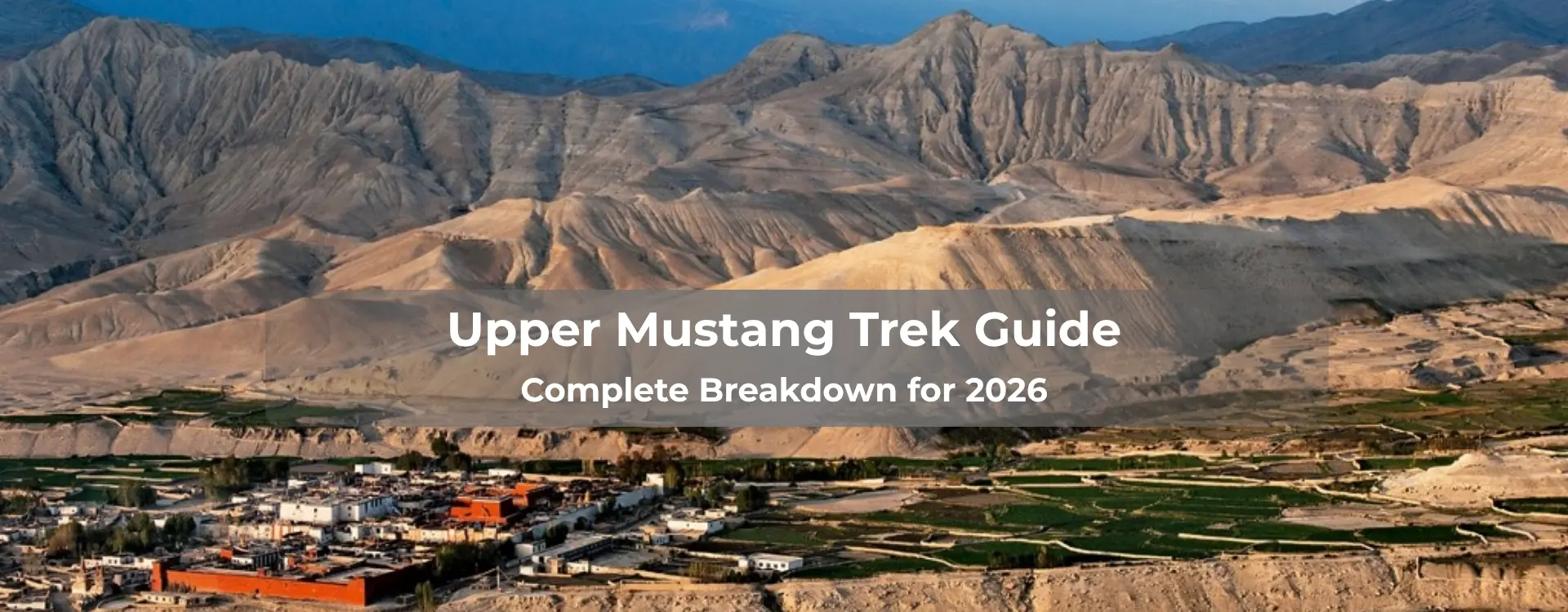
The monsoon season dries up the trekking interest by a noticeable margin. This is because many trails to base camps are affected by the rains and unpredictable weather. While the rest of Nepal drowns in the monsoon rains, Upper Mustang remains bone-dry under the cloudless sky. The Trek remains one of the unique treks and breaks many rules that you’ve learned about Himalayan Trekking. In this Upper Mustang Trek guide, we’ll go over everything you need to know before embarking on your ultimate adventure, including cost, daily itinerary, permits, and the best time to visit.
The trek is the complete opposite of the Everest Base Camp Trek—no crowds, no green hills, and no familiar routine. Instead, you’ll experience a completely different landscape and a culture more than 1,000 years old, offering an adventure unlike any other.
Since March 2026, the Government of Nepal has lifted the two-person minimum for trekking in Upper Mustang. You can now trek solo as long as you hire a licensed guide. The permit system has also changed. Instead of a flat $500 fee, permits now cost $50 per day—making Upper Mustang more accessible for trekkers looking for experiences beyond the mountains.
eBctrails operates a 16-day thrilling Upper Mustang Trek experience with a veteran guide and thorough itineraries. You can contact us if you require personalized information or for booking.
What Makes Upper Mustang Unlike Any Trek in Nepal
A Kingdom That Didn’t Stop Being One
Upper Mustang was the Kingdom of Lo until 2008, when Nepal’s republican transition formally dissolved its sovereignty. The king still lives in Lo Manthang. His subjects—the Loba people, who speak an archaic Tibetan dialect and have maintained a distinct culture for centuries—still live there too. This is not a heritage reconstruction. It is not a museum. It is a community that continued largely on its own terms while the rest of the world updated its maps.
Nepal only opened Upper Mustang to foreign trekkers in 1992. Everest Base Camp has been accessible since the 1950s. That 40-year gap in openness is visible in everything: the architecture, the monastery murals, the fact that there is no souvenir market in Lo Manthang.
The Landscape Has Nothing in Common With the Rest of Nepal
If you come expecting the Nepal that you’ve seen in photographs—rhododendron forests, green hillsides, and glacial moraines framed by the world’s highest peaks—Upper Mustang will confuse you. That is not a flaw.
The Annapurna and Dhaulagiri ranges block the monsoon. What sits behind them is a high-altitude desert: eroded red and ochre cliffs, wind-carved canyons, ancient salt trade routes, and whitewashed mud-brick towns that look more like western Tibet than anything else in Nepal. The color palette changes when you cross Kagbeni heading north. The greens disappear. What replaces them takes a day or two to read properly.
Thousands of man-made caves are cut into sheer cliff faces throughout the region—some above 50 meters, accessible only by rope ladder. Nobody has fully figured out who built them or why. Some predate the Kingdom of Lo by over a thousand years.
Upper Mustang Trek Permits 2026—The Complete, Up-to-Date Guide
Three separate permits are required for Upper Mustang. None are optional, and each is checked at multiple points along the route. Getting one wrong doesn’t mean a warning—it means being turned back, fined, and removed from the zone. Here is exactly what you need.
The Three Permits (2026 Costs at a Glance)
| Permit | Foreign Trekker | SAARC National | How to Obtain |
| Restricted Area Permit (RAP) | $50 USD/person/day | $25 USD/person/day | Registered agency only |
| ACAP (Annapurna Conservation Area) | ~$30 USD / NPR 3,000 | ~$8 USD | Registered agency |
| TIMS Card | $20 USD | — | Registered agency |
The RAP is the one that causes the most confusion, so it deserves a plain explanation before anything else.
What Changed in 2026 and Why It Matters to Your Budget
Until late 2025, the Restricted Area Permit charged a flat $500 regardless of how many days you actually spent inside the zone. A 7-day trek and a 14-day trek cost the same. The system penalized shorter itineraries and rewarded no one.
As of November 2025, Nepal’s Department of Immigration moved to a per-day model: $50 per person per day, calculated from the moment you cross Kagbeni heading north. A 7-day restricted area stay now costs $350. A 10-day stay costs $500—identical to the old flat rate. Go longer, and you pay more, but you’re also spending more time in one of the most deliberately limited trekking zones in Asia.
For budget-conscious trekkers planning 7–8 day itineraries, that’s a saving of $100–$150 per person. For 14-day trekkers, the cost increases — but by then, you’ve already decided the trip is worth it. Either way, the new system reflects what you’re actually doing, which is fairer than what came before.
Solo Upper Mustang Trek in 2026—What’s new
As of March 2026, the two-person minimum rule has been officially lifted. You can now hold an Upper Mustang trek permit in your own name as a solo traveler.
What this does not mean: you can trek Upper Mustang without a guide. A government-licensed guide remains legally mandatory. This is enforced at every checkpoint—Kagbeni, Chele, Syangboche, and Lo Manthang—and attempting to pass without one results in permit cancellation and removal from the zone. The solo rule change affects the size of your party. The guide requirement has not changed and will not change.
If you’re planning a solo trip, confirm with your agency that a guide is registered specifically to your individual permit, not as a group attachment on a shared booking. The distinction matters at checkpoints, and a reputable agency will know this without being asked.
How to Get Your Permits—Step by Step
- Choose a government-registered Nepali trekking agency. Restricted area permits cannot be obtained independently — the law requires agency facilitation, and there are no exceptions.
- Submit your passport copy, Nepal visa details, and planned entry and exit dates for the restricted zone.
- Your agency applies through Nepal’s Department of Immigration in Kathmandu or Pokhara.
- Processing takes 1–2 working days in off-peak months. In April and October, allow 3–4 days.
- Carry printed originals at all times. Checkpoints do not accept phone photos or digital copies.
One thing most guides skip: permits are issued for specific dates. If a weather delay pushes your Jomsom flight back a day, your entry date shifts—and your permit needs updating before you reach Kagbeni. A competent agency handles this routinely, but confirm the process with them before you travel. Discovering the mismatch at the checkpoint is not a good experience.
What Happens If You Enter Upper Mustang Without Valid Permits
This comes up because some trekkers assume the remoteness of the Upper Mustang Trek means lax enforcement. It doesn’t. Checkpoints at Kagbeni and beyond run regular document checks, and enforcement is taken seriously precisely because the restricted area designation is tied to Nepal’s international conservation commitments.
Trekkers caught without valid permits face fines starting at NPR 50,000 (roughly $375 USD), immediate removal from the restricted zone, and a formal record on their Nepal entry file that can affect future visa applications. The fine is the least of it—the disruption to a trip that cost thousands to plan is the real consequence.
Most Upper Mustang itineraries are built around the permit minimum, not around what the trek actually deserves. eBcTrails’ 16-day route gives both the ascent and the return route the space they need—including a full exploration day in Lo Manthang and the rarely-taken Yara–Tangge return loop that most shorter packages cut.
Upper Mustang Trek Itinerary—The Realistic 16-Day Route
Day-by-Day Overview
| Day | Route | Altitude | Walking Time |
| 1 | Arrive Kathmandu | 1,350 m | — |
| 2 | Kathmandu → Pokhara (drive) | 822m | 6–7 hrs drive |
| 3 | Pokhara → Jomsom (flight) → Kagbeni | 2,810m | 3–4 hrs |
| 4 | Kagbeni → Chele | 3,055 m | 5–6 hrs |
| 5 | Chele → Syanboche (via Taklam La, 3,625m) | 3,930m | 5–6 hrs |
| 6 | Syanboche → Ghami (via Nyi Pass, 4,010m) | 3,520m | 5–6 hrs |
| 7 | Ghami → Charang (via Tsarang La, 3,870m) | 3,560m | 5–6 hrs |
| 8 | Charang → Lo Manthang (via Lo Pass, 3,850m) | 3,810m | 5–6 hrs |
| 9 | Lo Manthang — rest and exploration | 3,810m | — |
| 10 | Lo Manthang → Yara (via Lo La Pass, 3,950m) | 3,650m | 6–7 hrs |
| 11 | Yara → Tangge | 3,340m | 6–7 hrs |
| 12 | Tangge → Chhusang | 2,980m | 8–9 hrs |
| 13 | Chhusang → Jomsom via Muktinath (3,750m) | 2,710m | 7–8 hrs |
| 14 | Jomsom → Pokhara (flight) | 822m | 25-min flight |
| 15 | Pokhara → Kathmandu (drive) | 1,350 m | 6–7 hrs drive |
| 16 | Final departure from Kathmandu | — | — |
Several days need more context than a table gives.
- Day 3 (Kagbeni): Entry point for the restricted zone and permit checks. Enjoy an easy 3-hour walk along the flat, windswept Kali Gandaki riverbed.
- Day 5 (Syanboche, 3,930m): The highest overnight stop of the trip. The day involves an 800m ascent from Chele; start early to avoid afternoon winds.
- Day 6 (Nyi Pass, 4,010m): The highest crossing of the trek. Prioritize hydration and steady pacing on the ascent, followed by a long, scenic descent to Ghami.
- Day 9 (Lo Manthang): A dedicated day to explore significant monasteries and museums. Bring small cash denominations for gompa entrance fees (approx. $10 each).
- Day 10 (Lo La Pass, 3,950m): The highest pass on the return route. Offers a dramatic descent through eroded cliffs toward Dhi and Yara.
- Day 12 (Tangge to Chhusang): The longest trekking day at 8–9 hours. Start at first light to navigate the route’s rocky formations and salt mines.
- Day 13 (Muktinath, 3,750m): Visit this sacred pilgrimage site, known for its 108 bathing spouts and natural gas flame, marking the end of the remote trek.
The Flight Dependency—Plan Around This
The Pokhara to Jomsom flight takes 25 minutes and operates only in the morning. Mountain winds close the Jomsom airstrip by 10–11am most days. Weather-related cancellations happen every season without exception. Build at least one buffer day into your itinerary—either in Pokhara before flying in or in Jomsom before flying out. Do not connect a Jomsom departure directly to an international flight from Kathmandu on the same day. It is a mistake trekkers make once.
Tiji Festival Timing—If You Can Time One Thing
The Tiji Festival takes place in Lo Manthang on May 13–15, 2026. Three days of ceremonial masked dance performed by monks of the Sakya lineage are one of the most significant events in the Himalayan calendar. eBcTrails offers dedicated Tiji Festival packages: a 15-day itinerary and a 21-day itinerary that combines the full Upper Mustang trek with festival attendance. Festival-timed departures fill 3–4 months in advance. If this is your window, book early.
Upper Mustang Trek Cost 2026—What You Actually Pay
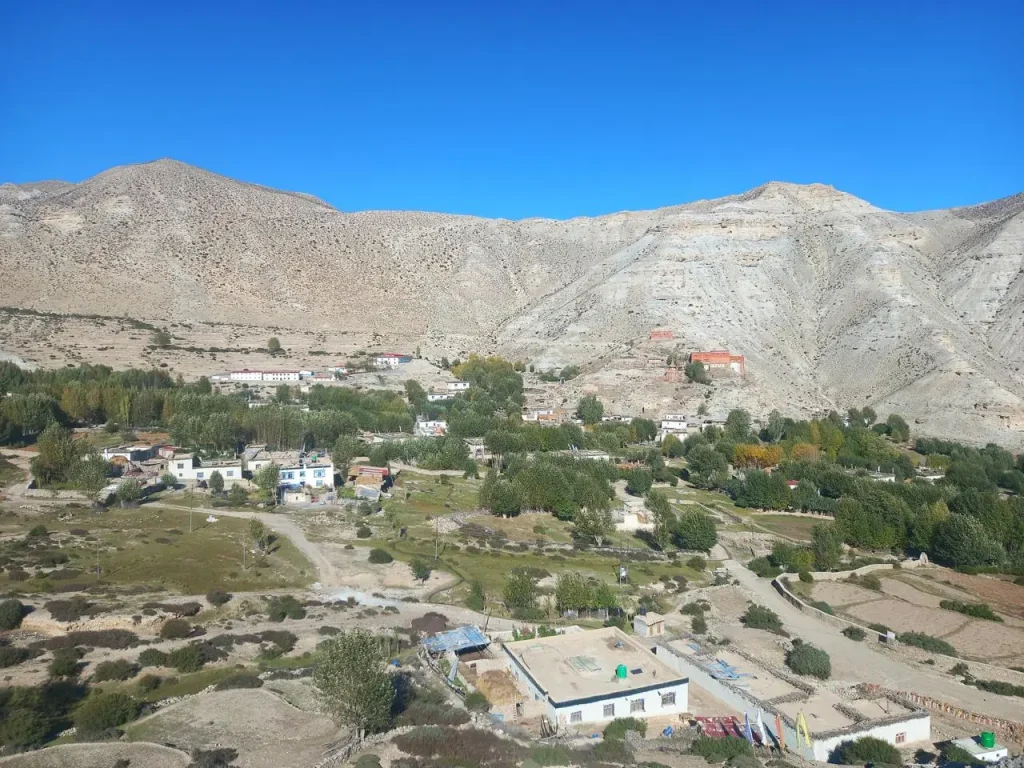
Upper Mustang costs more than most Nepal treks. That’s true, and it’s worth understanding why before the numbers land.
The Restricted Area Permit is the primary driver. At $50 per person per day inside the restricted zone, the eBcTrails 16-day itinerary involves approximately 10–11 days north of Kagbeni—putting the RAP alone at $500–$550 per person. Add the ACAP permit, TIMS card, licensed guide, porter, transport, accommodation, and meals across 16 days, and the cost reflects what you’re actually doing: a two-week trek through one of the most deliberately limited-access regions in Asia.
Package Pricing—By Group Size
| Group Size | Price Per Person |
| 1-2 trekkers | $1,900 USD |
| 3–5 trekkers | $1,800 USD |
| 6–8 trekkers | $1,750 USD |
| 9–10 trekkers | $1,700 USD |
Solo travelers can now book under the 2026 solo rule—confirm current solo pricing directly with eBcTrails, as the per-person rate for a single-person booking differs from group rates.
What the Package Includes
The eBcTrails package is all-inclusive for the trek itself. Specifically:
- Private airport transfers in Kathmandu
- All meals on trek—breakfast, lunch, and dinner throughout the 16 days
- Licensed trekking guide and shared porter (one porter per two trekkers)
- All permits: Restricted Area Permit, ACAP, and TIMS
- Teahouse accommodation throughout the trek
- Tourist bus Kathmandu–Pokhara both ways
- Scenic flight Jomsom–Pokhara on Day 14
- Farewell dinner in Kathmandu on the final evening
- Emergency evacuation support
- All government taxes
What It Does Not Include
These are the costs you carry separately, and they add up faster than most trekkers expect:
- Nepal visa: ~$30 USD, paid on arrival at Tribhuvan International Airport
- International flights to and from Kathmandu
- Hotel accommodation in Kathmandu and Pokhara before and after the trek
- Travel insurance — this is not optional (see below)
- Personal expenses on trail: hot showers, Wi-Fi, device charging, snacks, extra beverages
- Tips for your guide and porter
- Gompa entry fees in Lo Manthang (~$10 per monastery)
- Any personal gear you need to buy or rent
Upper Mustang Trek On-Trail Cash—How Much to Carry
There are no ATMs past Jomsom. The last reliable ATM is in Pokhara. Withdraw everything you need before the trek begins.
Budget NPR 25,000–35,000 (roughly $190–$265 USD) in cash for 16 days of personal trail expenses. The breakdown typically looks like this:
- Hot shower: NPR 200–400 per shower ($1.50–$3 USD)
- Device charging: NPR 200–300 ($1.50–$2.50 USD)
- Wi-Fi per session: NPR 100–300 ($0.75–$2.50 USD)
- Gompa entry fees in Lo Manthang: approximately $10 per gompa, three to four major sites
- Bottled water or snacks: NPR 100–250 per item ($0.75–$2 USD)
- Tips for guide and porter: budget $10–15 per day for your guide and $8–10 per day for a porter—for a 16-day trek, roughly $160–$240 for the guide and $128–$160 for a porter
Tipping is not a formality. Your guide will have carried permits, navigated logistics, interpreted culture, and managed your safety across 16 days at altitude. The amounts above are standard, not generous.
Travel Insurance—Non-Negotiable
Helicopter evacuation from Upper Mustang costs $3,000–$6,000 without insurance. AMS, injury, and sudden illness are real scenarios at these altitudes—Syanboche sits at 3,930m, and you cross a 4,010m pass on Day 6. No travel insurance that excludes high-altitude helicopter evacuation is adequate for this trek. Verify your policy covers evacuation above 4,000m before you leave home.
Why Upper Mustang Trek Costs More Than EBC—The Honest Version
Everest Base Camp has no restricted area permit. Upper Mustang has one, and it costs $50 per person per day. That single difference accounts for $500–$550 of the cost gap. The remoteness of Upper Mustang also raises supply chain costs—food and accommodation prices on the trail run 20–40% higher than comparable teahouses on the Everest or Annapurna routes. You’re not paying a premium for branding. You’re paying for what the permit system actually provides: a trekking zone that sees fewer than 1,000 foreign visitors per year.
Best Time for Upper Mustang Trek—Month-by-Month Breakdown
Most Nepal trekking guides give you two windows: spring and autumn. Upper Mustang doesn’t follow that pattern. The rain-shadow geography changes the calculation entirely, and if you’re choosing your dates without understanding it, you’re likely ruling out one of the best times to go.
Spring: March to May
The most popular season. Expect clear skies and mild temperatures (8–20°C). May is ideal for the Tiji Festival (May 13–15, 2026), but book early. Be prepared for afternoon wind and trail dust from April onwards.
Monsoon: June to August
A hidden gem for value and solitude. The region remains dry due to the rain shadow. Trails are uncrowded and the air is clear, though flight delays into Jomsom are more frequent. Plan for extra buffer days.
Autumn: September to November
Offers the year’s clearest Himalayan views. October is peak season (book by July), while November is quieter and cooler. Excellent for photography and mountain visibility.
Winter: December to February
Extremely cold (dropping to -15°C) with limited teahouse services. Not recommended for first-timers; suitable only for experienced, well-equipped winter trekkers.
Quick Reference
| Season | Conditions | Crowds | Relative Cost | Best For |
| Spring (Mar–May) | Warm, some wind/dust | High | $$ | Tiji Festival, first-timers |
| Monsoon (Jun–Aug) | Dry in Mustang, flight delays possible | Low | $ | Value, solitude |
| Autumn (Sep–Nov) | Clearest views of the year | High (Oct peak) | $$$ | Mountain visibility |
| Winter (Dec–Feb) | Cold, limited services | Very low | $ | Experienced only |
Upper Mustang Trek Difficulty—What to Expect
Grade: The Upper Mustang Trek falls in the moderate category. No technical climbing, no ropes, no crampons. What the grade doesn’t capture is the cumulative demand—16 days of consecutive walking, several of them above 3,500m, on exposed and often windy terrain.
Daily walking runs 5–9 hours. Day 12 (Tangge to Chhusang) is the longest at 8–9 hours and should be treated seriously. The highest crossing is Nyi Pass at 4,010m on Day 6, and Syanboche at 3,930m is your highest overnight—both higher than Lo Manthang itself, which surprises most trekkers.
Afternoon winds above Kagbeni are consistent and strong. They don’t stop the trek, but they slow it down and wear you out more than the elevation does on some days.
Who this suits: The Upper Mustang trek suits motivated first-timers with reasonable fitness, returning trekkers, older adults in good health, and families with children 12 and above. Anyone with untreated cardiovascular or pulmonary conditions should get medical clearance before booking.
Preparation in brief: Eight weeks is enough if you use them. Weeks 1–2: daily 30-minute walks. Weeks 3–4: 60–90 minute hikes three times a week; add stairs with a light pack. Weeks 5–6: half-day hikes with a 6–8kg loaded pack. Weeks 7–8: one full-day hike on varied terrain. The goal isn’t fitness performance—it’s making 6 hours of daily walking feel routine before you arrive.
AMS: The risk is real but manageable. Gain altitude gradually, drink 3–4 liters of water daily, avoid alcohol on the trail, and recognize the early symptoms—headache, nausea, and disrupted sleep. Your eBcTrails guide is trained in AMS recognition. If symptoms appear, tell them immediately. Descending 300–500m resolves most cases within hours.
Lo Manthang and What You’ll Find There
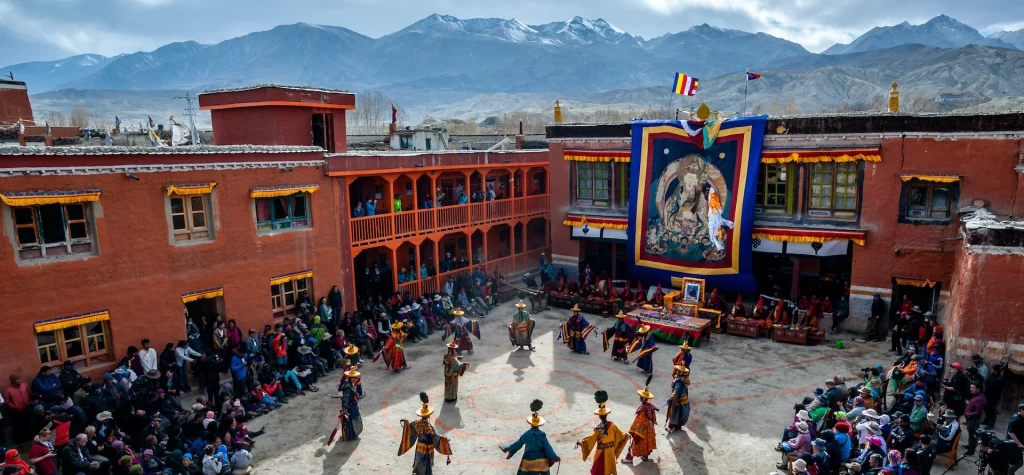
Lo Manthang sits at 3,810m and looks, from a distance, exactly like what it is: a walled medieval city that has been continuously inhabited for over 600 years.
Inside the walls, the streets are narrow, the architecture is low and dense, and the four major gompas—Thubchen, Jampa, Chode, and Chodey—contain murals and religious art that predate most of what you’ll find in comparable Tibetan Buddhist sites elsewhere. Thubchen Gompa’s interior, with its large clay statues and painted walls, is the most immediately striking. Entry to each gompa is around $10—carry small notes; change is not reliably available.
The royal palace still stands at the northern end of the city. The king no longer holds formal political authority following Nepal’s 2008 republican transition, but the palace remains and the family’s cultural significance in the community is intact.
Sky caves appear throughout the region—thousands of man-made chambers cut into sheer cliff faces, some above 50 meters, accessible historically only by rope ladder. Who built them and precisely when remains partially unresolved. Some predate the Kingdom of Lo by over a thousand years. The largest concentration is near Chhoser, north of Lo Manthang, accessible as a day excursion.
Tiji Festival: The festival runs May 13–15 in the monastery courtyard. Arrive the day before to settle in. Position yourself at the courtyard entrance early on Day 1—the first morning’s ceremonies draw the largest crowds. Follow your guide’s direction on proximity to the monks and ask before photographing at close range. The ceremony is not a performance staged for visitors—it is a ritual the community has observed for centuries. Behave accordingly.
Cultural etiquette that actually matters:
- Walk clockwise around chortens, mani walls, and monasteries without exception.
- Remove shoes before entering any gompa, even if others ahead of you don’t.
- Ask before photographing local people—a gesture and eye contact are enough.
- ‘Tashi Delek‘ is the traditional Loba greeting. Using it opens more doors than any translation app.
- Do not buy or attempt to buy antique religious objects. Many are protected cultural property, and the market for them directly funds looting of the sites you’ve come to see.
- Drones require a separate special permit in restricted areas. Flying one without it is a fineable offense enforced at checkpoints.
Practical Upper Mustang Trek guide—Accommodation, Food, Cash, and Connectivity
- Teahouses: Basic lodging with shared facilities is standard. Lo Manthang offers select rooms with attached bathrooms. Advance booking is only necessary during the Tiji Festival.
- Food: Local staples (dal bhat, momos, etc.) are available; menus narrow at higher altitudes. Prices are 20–40% higher than in Pokhara. Consume only cooked food and treated or bottled water.
- Cash: No ATMs past Jomsom. Carry NPR 25,000–35,000 in cash for personal expenses (showers, Wi-Fi, and tips). Cards are not accepted.
- Connectivity: Signal is intermittent, becoming unreliable above Chele and in Lo Manthang. Download offline maps like maps.me or Google Maps offline and rely on your guide for navigation.
- Emergency & Insurance: Travel insurance covering helicopter evacuation above 4,000m is mandatory (evacuation costs $3,000–$6,000). Your guide is trained in AMS recognition and first aid.
Frequently Asked Questions on Upper Mustang Trek Guide
Can I do Upper Mustang Trek solo in 2026?
Yes. The two-person minimum rule was officially lifted as of March 2026. You can now hold a Restricted Area Permit in your own name as a solo traveler. A government-licensed guide remains legally mandatory regardless—this is enforced at every checkpoint and has not changed. “Solo” means without other trekkers, not without any staff.
Do I need a guide for Upper Mustang Trek?
Yes. A government-licensed guide is legally required and enforced at multiple checkpoints. There are no exceptions. Attempting to enter the restricted zone without one results in permit cancellation and removal from the zone.
How do I get to Upper Mustang from Kathmandu?
Kathmandu to Pokhara by tourist bus (6–7 hours) or domestic flight (25 minutes), then a 25-minute scenic flight from Pokhara to Jomsom, then a 3–4 hour walk or short drive to Kagbeni—the gateway to the restricted zone.
Is Upper Mustang Trek better than Everest Base Camp?
They’re different treks for different reasons. EBC is a high-altitude pilgrimage to one of the world’s most iconic mountain settings. Upper Mustang is a cultural and desert-landscape immersion at a lower maximum altitude with less crowd and more historical depth. Upper Mustang is the better choice if culture matters as much as scenery. Neither is objectively superior—the right answer depends entirely on what you’re looking for.
Final Thoughts on Upper Mustang Trek guide
Upper Mustang is not Nepal’s most dramatic altitude. It’s not its most famous trek. What it is—and what very few places anywhere in the world still manage to be—is genuinely remote, genuinely preserved, and genuinely indifferent to what trekking trends are doing elsewhere.
The 2026 permit restructuring and the solo rule change make this a better moment to go than it was two years ago. The trail is less crowded than the EBC or Annapurna Circuit by design, and that design is funded by the permit you pay for. The cost reflects what you’re getting: two weeks in a living medieval kingdom that fewer than 1,000 foreign trekkers visit per year.
Three things to do now if you’re seriously considering it:
- Pick your season—spring for the Tiji Festival, autumn for the clearest views, or monsoon if you want the trail to yourself.
- Start your eight-week training plan. Not when you book. Now.
- Contact eBcTrails to confirm availability and lock in your dates—Upper Mustang departures, especially festival-timed ones, fill well ahead of the season.
The Kingdom of Lo has been there for six centuries. It will wait. But your departure window won’t.
Book Your Upper Mustang Trek with eBcTrails →
Still comparing options? See how Upper Mustang fits alongside the Everest Base Camp Trek, the Annapurna Circuit Trek, and the Manaslu Circuit Trek.


